17 May 2009

THE LIMITS OF CONTROL


Few films baffle me as much as this one initially did. Jim Jarmusch has always been a particularly austere auteur: his narratives tend to unfold at a zen-like pace and the films' structures possess as much weight as the stories themselves. Here, he takes that approach to an extremely uncomfortable level, perversely following the accessible, practically sentimental BROKEN FLOWERS with this, his most challenging, poker-faced effort.

A "Lone Man" (that's the character's only name according to the credits) played by Isaach De Bankolé is given instructions from two other men to check into a particular hotel, go to a cafe and wait for "the man with the violin". Having dutifully followed these instructions, Lone Man gives Violin Man a matchbook, receives another one in return, finds a small piece of paper with a cryptic code of numerals and letters on it, and proceeds to stick it in his mouth, chew it up and swallow. This interaction leads him to another figure, an affected, quirky (in a Jarmusch film, is there any other kind?) Blonde (Tilda Swinton). A similar exchange follows and repeats itself as Lone Man travels from one part of Spain to the next, meeting such figures as Guitar (John Hurt), Mexican (Gael Garcia Bernal) and finally, a Dick Cheney-like American (Bill Murray) where we finally learn this mission's purpose.

Or maybe not. Jarmusch reveals precious little more information than what I've given here. We never find out what that elusive code is, or why Lone Man always drinks his double espresso in two separate, identical cups, or why he's even been asked to perform this mission and what its repercussions are. In short, Jarmusch has cut out nearly all exposition and backstory: what we see is what we get. For anyone looking for a good story or a rich character study, this may not be enough, which is why I left the theater confused and more than a little annoyed.

And yet, there was so much about the film that I liked. The repetitions and rituals form a hypnotic rhythm that, as in the best experimental cinema, makes you occasionally forget about the lack of narrative momentum. The Christopher Doyle cinematography is typically captivating without calling too much attention to itself. And for all his minimalist demeanor, De Bankolé is a fascinating figure. He's in nearly every frame, but he moves through these landscapes as if he's a fully integrated component rather than someone who blinds us with his star presence.

Jarmusch always includes a fair amount of pretentious bullshit in his films. This one is just as pretentious, but, with perhaps the exception of the Bill Murray scene, it's bullshit-free. He's working toward a pure, instinctual cinema that's much closer to the work of Antonioni and Chantal Akerman than his American indie contemporaries. THE LIMITS OF CONTROL frustrates because it has that dangling carrot of a story that Jarmusch eventually snatches away. In his next film, I'd like to see him try excluding that carrot entirely.

10 May 2009

WALK THROUGH BEACON HILL

Roughly once a year, I head over to Beacon Hill for a walk. Each time, I'm always surprised by its little quirks. The signature narrow, winding streets are a given, but many of its architectural details are enticingly hidden, just waiting to be discovered.

This tour begins with a colorful intrusion among the skyscrapers Northeast of Boston Common, then proceeds through the neighborhood:


06 April 2009

PORTLAND SIGNS

That would be Portland, Maine, where I spent the past weekend. For being the largest city in the state, it's fairly small and all the more charming for it. These were taken Downtown near the waterfront--a neighborhood that is alternately old school and nouveau-trendy.


05 March 2009


What me, lazy? Nonsense. Expect few updates here for another month or so. Blame work, various extracurriculars, and a big move looming ahead. Once I get settled in my new digs, perhaps you'll see a little more action from this blog.

Until then, wait in anticipation like Maggie.

02 February 2009

THAT'S LAME, BOB!

Thanks to Youtube (and this page in particular), I’ve come across a lot of stuff I haven’t thought about in years. Much of it is junk—perhaps some proof that we are more apt to remember the good, significant, relevant things television subjected us to decades ago. Social historians (and pop culture geeks like me) must be having an orgasm because all of the, um, archival footage now available to us for free.

Of course, Youtube can’t take all the credit. Sometimes, a simple phrase can conjure up a flood of long-suppressed memories. While watching the AKC/Eukanuba National Championship dog show over the weekend, the words, “That’s right, Bob!” did this to me. They were spoken repeatedly to the show’s host, Bob Goen, by various dog handlers and trainers, and the phrase triggered something that had left my consciousness twenty years ago.

If you’ve ever watched Milwaukee television, you know Colder’s, a local furniture and appliance store. Much like Bernie and Phyl’s or Bob’s Discount Furniture in New England, they’ve advertised incessantly for as long as I can remember. In the ‘80s, they had a spokesperson named (surprise, surprise) Bob who was an unexceptionally dorky, bespectacled middle-aged Midwesterner. Their cheaply-made commercials were mostly bland and forgettable, irritating only because it seemed like they aired every five minutes.

Which brings us to “That’s right, Bob!”, a series of radio and TV ads. The premise: Bob does his usual spiel, hawking whatever living room set or refrigerator was on sale that week, only he phrases it in the form of a question, not as Alex Trebek but as if he was Pat Sajak shooting the shit with Vanna White.

Of course, Colder's couldn't hire the real Vanna at height of her Wheel of Fortune fame, so they improvised. A typical exchange would go something like this:

Bob: “Vanna White, isn’t it true that the 1988 Fridgidaire deluxe model with automatic icemaker and patented sta-kleen vinyl handle can be yours at Colder’s this week with no payments down and no interest until 1990?”

“Vanna”: “That’s right, Bob!”

Two or three more questions would follow and "Vanna" always gave the same three-word response. I first heard the radio version, where the voice of "Vanna" was mousy, rapid and obviously fake, as if a man was saying it. By itself, that would have been mildly amusing (and to most kids my age it was).

Unfortunately, they just had to make a TV version where "Vanna" is a life size cardboard cutout of Ms. White. The exchange played out like the radio ad, only Bob communicated with "Vanna" as a ventriloquist would with his dummy—and with little effort to not show his lips moving as he mouthed the ad's infamous catch phrase. He even chuckles at the end, as if to say, "Gosh darnit, can you believe how dorky I am?"

WILL SOMEBODY POST IT ON YOUTUBE, ALREADY?

Eventually, the radio ads were amended to make Vanna's voice sound a little less fake. "That's right, Bob!" became throatier, more feminine, and a little saucier. That did not keep my friends and I from saying it to each other in a chipmunk cadence, though.

Here's a few other old Milwaukee commercials I'd kill to see on Youtube again:

Gordon's Furniture: Not too strong of a competitor to Colder's, this smaller business had to make do with freeze frame stills of their merchandise and voiceover copy. But the ads always ended with eerie, disembodied voices saying "Gordon's" in triplicate before being topped off with an unnerving musical cue that sounded like it was straight out of an old science fiction flick without really meaning to.

Tadych: Another furniture store, even tinier than Gordon's, and only a few blocks away from my house. In addition to promoting fine Amish handiwork (again accompanied by still shots of "Amish" carpenters at work... I always yelled at the screen, "Oh, they're not really Amish—those beards are taped on!"), they had a chintzy felt toad with someone's hand up its back, belching out the store's name as if it was "Ribbit!", closing out with a big BOOI-NNNG! on the soundtrack as it pounced toward the camera for its close-up.

And bonus points for anything with the polka-like theme for Ernie von Schledorn's auto dealership (which always ended with Ernie croaking, "Who do you know vants to buy a car?" like a benevolent German priest) or the totally groovy circa-1970 jingle for Mike Crivello's Wonderful World of Cameras, whose original recording was still in use not too long ago!

23 January 2009

GOLDEN

Wow... having seen every episode of this sitcom (at least twice!), I have to say... well, what else is there to say about this music video by the band Pistol Youth, except... wow? Genius and disturbing in equal dosages.

14 January 2009

THE BEST FILMS OF 2008

This was not such a great year for film – I saw three of my top five in Toronto in 2007. However, I've never had so much difficulty choosing a number one film: I like the top two almost equally, but when it comes to ranking personal taste, I don’t believe in ties.

THE TOP TEN:


1. MAN ON WIRE
Philippe Petit’s 1974 tightrope walk across the World Trade Center could’ve easily made for a better-than-average cable TV documentary, but director James Marsh knew this extraordinary story was too good for that. With its unforgettable protagonist, quirky accomplices, marvelous archival footage and possibly the least cheesy reenactments ever, this is both an artful heist film and a celebratory document of a phenomenal stunt that was also a breathtaking work of art. But the film’s real power derives from it being just as much a requiem – although Marsh never directly references 9/11, the haunting presence of the Twin Towers themselves never lets you forget what was lost.


2. LET THE RIGHT ONE IN
From TWILIGHT to TRUE BLOOD, it seemed like vampires were everywhere in pop culture this year; this Swedish import offered a recognizable but fairly innovative take on the legend and managed the neat feat of a being a tender, coming-of-age love story and a bloody horror film. Set in an early-‘80s Stockholm suburb and centered on a shy, tormented 12-year-old boy and his new, oddly androgynous neighbor (who confesses to having been “12 for a long time”), Tomas Alfredson’s debut feature mixes genres with an uncommon assurance and does not hit one wrong note.
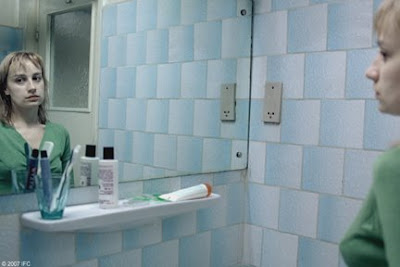


3. 4 MONTHS, 3 WEEKS, AND 2 DAYS
Two college-aged women trying to secure an illegal abortion in Communist Romania doesn’t exactly sound like a fun time at the cinema (it wouldn’t make an ideal date film), but for all its bleakness and utter discomfort, Cristian Mungiu’s Cannes winner is, in a strange way, kind of fun. It gains considerable momentum from its construction as a thriller as it examines the contours of a friendship against a social backdrop it neither entirely condemns nor commends; its generous helping of black humor is also far more evident once it’s over.


4. MY WINNIPEG
I should just automatically reserve a spot for Guy Maddin on my top ten every year he makes a new feature – he’s the most original filmmaker at work today. With this strange, charming documentary/fantasy/essay hybrid, he cements his reputation as one of the best. For all its wildly imaginative tales of frozen horses, man pageants and “psychic possibilities”, this is Maddin’s most accessible, personal work and if that wasn’t enough, you have the added attraction of the glorious, irascible 86-year-old Ann Savage in her final role as Maddin’s mother.


5. THE VISITOR
When I first saw it over a year ago, I feared that Thomas McCarthy’s intelligent little film would never find an audience. Its account of a gloomy widower (Richard Jenkins in one the year’s best performances) obtaining a new lease on life via the immigrant couple he befriends could have been rendered in broad, sentimental terms; instead, the story is told with nuance and restraint, even as it evolves from a bittersweet character study into an impassioned critique of American policy toward foreigners post-9/11. That it did find a sizable audience is enough to restore my faith in film distribution.


6. REPRISE
The Norwegian TRAINSPOTTING, only with mental illness and existential despair in place of the heroin and booze? Perhaps. Joachim Trier’s film is far from unique in how it revels in the ebullience of having an entire adulthood ahead of one's self, but it’s the rare one that considers all the anxieties and uncertainties that come with the territory; that it does so with detached wisdom and grace keeps it from feeling contrived.


7. FLIGHT OF THE RED BALLOON
Inspired by Albert Lamorisse's classic 1956 short THE RED BALLOON, Taiwanese master Hou Hsiao-Hsien seeks Paris as a thoughtful tourist would, freshly viewing the city’s day-to-day rhythms with the same sense of discovery found in his Asian films. Emphasizing textures and title-referencing motifs that subtly surface throughout, he’s created his most engaging, affable work to date without compromising his poetic approach.


8. SYNECDOCHE, NEW YORK
In his directorial debut, screenwriter Charlie Kaufman burrows even further down his own rabbit hole, forging a universe nearly brought to the brink of collapse by its art/life collisions and mind-blowing meta-references. Fortunately, it’s never less than a fascinating place to inhabit, aided by a brave performance from Philip Seymour Hoffman and a stellar, mostly female supporting cast. An absolutely terrifying comedy, it also resonates more profoundly than any of Kaufman’s previous efforts – especially with repeated viewings.


9. HAPPY-GO-LUCKY
Only Mike Leigh could devise a heroine like Poppy (the magnificent Sally Hawkins), an eternally optimistic London schoolteacher whom, in a lesser director’s hands, would come off as infuriating and abrasive. But, for all her whimsy and light, she’s one of his most intricate creations, and much more than she appears on the surface. Although a little pokey, this comparatively lighthearted Leigh film is as full of substance as his best work, and Hawkins’ scenes with her hotheaded driving instructor (Eddie Marsan) are an unusual, beguiling cross between screwball comedy and kitchen sink realism.


10. STILL LIFE
For years I’ve tried to figure out what the fuss with critically-adored Chinese filmmaker Jia Zhangke was all about: whereas his past films, although full of great ideas, somehow always lost their grasp along the way, this one stays afloat from beginning to end. A beautiful meditation on the Three Gorges Dam, it examines a small village that was destroyed by the project through the eyes of two characters who return to seek out displaced family members. The gorgeous, languid camerawork is a huge part of the appeal, but STILL LIFE is more than just a pretty travelogue – it documents a historical moment, and via its two stories, the human cost of it.

HONORABLE MENTIONS:

WALL-E
The first half is simply genius; if the more conventional remainder sustained its weird poetry, the whole thing might have been my favorite film of the year.

CHRIS AND DON: A LOVE STORY
A documentary about the writer Chris Isherwood and his lover Don Bachardy and an illuminating portrait of any long-term relationship, gay or otherwise.

ENCOUNTERS AT THE END OF THE WORLD
Werner Herzog goes to Antarctica (some filmmaker had to) and he finds pure shimmering beauty in its extreme icy terrain – not to mention a woman who can fold herself up inside a suitcase.

I’VE LOVED YOU SO LONG
Kristin Scott Thomas mesmerizes as a woman just released from a fifteen-year prison sentence in this unsentimental French drama that puts THE SHAWSHANK REDEMPTION to shame.

THE UNIVERSE OF KEITH HARING
With its one-of-a-kind subject having died so young, this is a vital document that aptly shows how Haring’s contributions to the art world continue to astound and inspire.

CHOP SHOP
BALLAST

Both Ramim Bahrani’s film about a young street orphan working in the vast junkyard next to Shea Stadium and Lance Hammer’s mournful character study in rural Mississippi are deeply indebted to Italian Neorealism; both also feel more honest and original than most of what screened at the indieplexes this year.

THE TRACEY FRAGMENTS
With a perfect meshing of story and style, this Canadian feature starring Ellen Page establishes a new creative standard for what one can accomplish with digital video.

MILK
Gus Van Sant makes an agreeable return to mainstream filmmaking with this biopic, but it’s an unexpectedly lithe, likable Sean Penn that really impresses in the titular role.

BILLY THE KID
Billy, a 15-year-old teenager in rural Maine, isn’t especially unique or exceptional, but after watching Jennifer Venditti’s perceptive, at times heartbreaking documentary, you’ll never forget him.

ALEXANDRA
Opera diva Galina Vishnevskaya anchors Aleksandr Sokurov’s anti-war film with a towering, tour de force display of tenacity and motherhood.

THE PRINCESS OF NEBRASKA
It will forever be known as the first feature film to have its premiere on Youtube, but this quite moving little experiment is not merely director Wayne Wang’s long-awaited return to form, but also an artistic breakthrough.

ALSO RECOMMENDED:

AT THE DEATH HOUSE DOOR
THE AXE IN THE ATTIC
THE BAND'S VISIT
BURN AFTER READING
A CHRISTMAS TALE
DOUBT
THE EDGE OF HEAVEN
FROZEN RIVER
JELLYFISH
LOVE SONGS
MISTER FOE
MISTER LONELY
PAGEANT
PARANOID PARK
RACHEL GETTING MARRIED
SONG SUNG BLUE
SURFWISE
TOWELHEAD
WATER LILIES
THE WITNESSES
XXY

06 January 2009

2008 BOOKLIST

A tradition I began last year, here's a rundown of what I read in 2008, followed by a few observations:

1. Watching TV, Harry Castleman and Walter J. Podrazik
2. The Water-Method Man, John Irving
3. Shakespeare: The World as Stage, Bill Bryson
4. George Mills, Stanley Elkin
5. Bangkok 8, John Burdett
6. Last Night at the Lobster, Stewart O'Nan
7. My Life in France, Julia Child with Alex Prud'homme
8. The Complete Persepolis, Marjane Satrapi
9. Physical Evidence: Selected Film Criticism, Kent Jones
10. Blind Willow, Sleeping Woman, Haruki Murakami
11. You Are Here, Daniel MacIvor
12. Derek Jarman: A Biography, Tony Peake*
13. Pieces of Soap, Elkin
14. Fear of Music: The 261 Greatest Albums Since Punk and Disco, Garry Mulholland
15. Rock On: An Office Power Ballad, Dan Kennedy
16. Cloud Atlas, David Mitchell
17. We Disappear, Scott Heim
18. The Pythons Autobiography, Monty Python
19. Polaroids From the Dead, Douglas Coupland
20. The Russian Debutante's Handbook, Gary Shteyngart
21. Skinny Legs and All, Tom Robbins*
22. When You Are Engulfed in Flames, David Sedaris
23. Norwegian Wood, Murakami
24. The Fortune Cookie Chronicles, Jennifer 8 Lee
25. A Wolf At the Table, Augusten Burroughs
26. A Short History of Nearly Everything, Bryson
27. The Bullfighter Checks Her Makeup, Susan Orlean
28. In the City of Shy Hunters, Tom Spanbauer
29. The Brief Wondrous Life of Oscar Wao, Junot Diaz
30. Sign 'O' The Times (33 1/3), Michaelangelo Matos
31. A Spot of Bother, Mark Haddon
32. But Enough About Me, Jancee Dunn
33. If You're Feeling Sinister (33 1/3), Scott Plagenhoef
34. Now It's Time to Say Goodbye, Dale Peck*
35. A Cinema of Loneliness, Robert Phillip Kolker
36. Selected Stories, Alice Munro
37. What I Talk About When I Talk About Running, Murakami
38. Downtown Owl, Chuck Klosterman
39. Let's Talk About Love: A Journey to the End of Taste (33 1/3), Carl Wilson
40. Bridge of Sighs, Richard Russo
41. The Sweet Hereafter, Russell Banks
42. Eat Me: The Food and Philosophy of Kenny Shopsin, Shopsin with Carolynn Carreno
43. The Corrections, Jonathan Franzen*
44. The Yacoubian Building, Alaa Al Aswany

*re-read

To break it down by genre, I read eighteen novels, two biographies, eight memoirs (including one that is also a graphic novel and another that is also a cookbook), four collections of essays, two collections of short stories, one play and nine other nonfiction books (three of which are part of this series).

I also re-read four books that I first picked up five-to-ten years ago. Tony Peake's superlative Jarman biography was specifically revisited for this project; the other three were fat, sprawling novels that meant a lot to me the first time around. I enjoyed revisiting all three, but the Jonathan Franzen book held up best, perhaps because I first read the other two months after finishing grad school - a particularly impressionable time for me.

This year, I made a conscious effort to read a diverse selection of authors and not get bogged down in devouring one writer's oeuvre (as I did with Bill Bryson in 2006-07). While a part of me wanted to check one Haruki Murakami book after another out of the library, I showed some restraint and read only three.

The longest book I read was a wonderful 600+ page compilation of Alice Munro short stories; the most difficult read by far was Stanley Elkin's dense but occasionally genius George Mills (with the "Sloosha's Crossin' An' Ev'rythin' After" section of Cloud Atlas a close second); the breeziest read was Jancee Dunn's account of writing for Rolling Stone - winning and entertaining but not fluffy; the biggest disappointment was Augusten Burroughs' shark-jumping book-long complaint about how his daddy didn't love him; the best surprise was Carl Wilson's gleeful, fascinating deconstruction of Celine Dion.

My five favorites from this list: #7 (rarely has such an infectious, engaging real-life personality ever translated so well on the page), #16 (like six novels for the price of one, only it really is one novel, and the echoes and connections within are astonishing), #20 (a wickedly funny debut that reads like a Gen-X Woody Allen crossed with Nabokov), #28 (an original, dazzling achievement that's even better than my favorite book from last year), and #40 (similar in theme and approach to the author's past work, but far more accomplished and affecting than his somewhat overrated Pulitzer winner.)

31 December 2008

BEST ALBUMS OF 2008: #1


1. Sam Phillips – DON’T DO ANYTHING

Twenty years after the former Leslie Phillips quit being a contemporary Christian artist and adopted her childhood nickname, she’s still making unconventional, vital music. Several tracks on her seventh album firmly carry over the acoustic/cabaret vibe of her previous two releases (like the infectious, celebratory “Sister Rosetta Goes Before Us”); others feature some of her sharpest hooks in well over a decade – for instance, “Little Plastic Life” crosses the jazzy, supple swing of A BOOT AND A SHOE with the Beatles-fixated choruses of MARTINIS AND BIKINIS. But a good chunk of DON’T DO ANYTHING delves into new terrain: “No Explanations” startlingly kicks things off with just Sam’s voice and a distorted electric guitar before a loud, primal stomp comes in, giving the song an uncommon thrust. The title track, “My Career in Chemistry”, and “Shake It Down” also employ these elements to great effect, with the latter concluding in a delicate fury of clanging (yet not entirely cacophonous) percussion. Although this is Sam’s first effort without her producer (and now ex-husband) T-Bone Burnett, it feels not entirely correct to simply dub it her “divorce album” or to say she’s newly independent. Always an iconoclast, she’s forever pushing forward. She delayed this album’s release by a few months to work a little more on it, but instead of feeling smothered or hermetic, the twelve concise miniatures contained here exude spontaneity, a cutting wit, and a radiance that pierces through all the anger and sorrow.

Favorite songs: “No Explanations”, “Little Plastic Life”, “My Career in Chemistry”, “Flowers Up”, “Sister Rosetta Goes Before Us”, “Watching Out of This World”

30 December 2008

BEST ALBUMS OF 2008: #2


2. TV On the Radio - DEAR SCIENCE

I overrated this band's last album - in an especially weak year for new music, it earned bonus points for originality. However, it's also a rather uneasy, challenging listen. Although I wouldn't hesitate to recommend it to someone who likes challenging music, I rarely feel the need to dial it up on the 'Pod these days. Thus, I approached this follow-up with some skepticism, weary of buying into the hype yet again. Fortunately, all my concerns dissipated within hearing the opener "Halfway Home" for the first time. The song itself is not a radical departure for the band, but everything about it - the handclaps, vocalist Tunde Adebimpe's euphoric "ba ba ba's", the extra guitars that crash in near the end - is so damn irresistible and inviting. Subsequent songs have that sense of immediacy even as they each sound like the work of a different band - one eclectic enough to make room for both "Dancing Choose", a half-rapped political song (with a bloodline you can trace back to "It's the End of the World as We Know It (and I Feel Fine)" and "Subterranean Homesick Blues") and something as sublimely beautiful and moving as the hazy, soaring "Family Tree". In short, they're now using their powers for good instead of evil, and it opens up the music's possibilities while also strengthening its impact.

Favorite songs: "Halfway Home", "Crying", "Dancing Choose", "Golden Age", "Family Tree", "DLZ"

29 December 2008

BEST ALBUMS OF 2008: #3


3. Stew and Original Broadway Cast - PASSING STRANGE

Five years ago, if you told me a musician as unique and obscure as Stew (a portly, middle-aged African American who fronts a band called The Negro Problem) would one day star in an award-winning Broadway musical, I would have laughed in your face. And yet, the former Mark Stewart actually did it, slowly developing his autobiographical show from small clubs to slightly larger venues (both in Berkeley and Off-Broadway) to a brief but celebrated run this year at the Belasco Theatre. This long-awaited cast album was recorded live before an audience on the Belasco's stage, which is only appropriate given that the production often plays more like a rock concert than a traditional musical. But unlike his previous albums (which, in their effort to encompass a multitude of genres tended to sprawl unevenly), this is a solid, complete work. It still includes everything from gospel, psychedelia and blues to punk, soul and a little calypso, but a compelling narrative and a canny use of countermelody and reoccurring hooks and phrases adds structure to the many shifts in style and tone. PASSING STRANGE ends up mocking musical conventions ("The Black One" slyly parodies A CHORUS LINE'S "One"), while also making the best of them in showstoppers like the career manifesto "Work the Wound".

Favorite songs: "Amsterdam", "Keys", "We Just Had Sex", "The Black One", "Work the Wound"

24 December 2008


Merry Christmas from Maggie, who is as happy here as a puppy nibbling on her kong toy can be. My best albums of the year countdown will resume on Monday and be completed before the new year rears its pretty little head.

BEST ALBUMS OF 2008: #4


4. Goldfrapp - SEVENTH TREE

I thought Alison Goldfrapp had truly found her niche churning out an electronic version of glam rock on her previous album SUPERNATURE, but I was wrong: this quite different, gorgeous comedown of a follow-up is an even better fit. The gentle, pastoral, somewhat eerie opener "Clowns" sets the tone, and the songs that follow sustain it even as they add a slight bounce to its step ("Happiness") or wash all over it with a psychedelic wall of sound ("Little Bird"). The second half is even better: the single "A&E" conveys what could be a suicide attempt with an irresistibly uplifting surge, "Cologne Cerrone Houdini" stimulates with its lush, pretty nonsense, and "Caravan Girl" convincingly rocks out with momentum before it all comes crashing down on the devastating closer "Monster Love". I used to think SEVENTH TREE would make a perfect summer album, but it's proving effective throughout all the seasons.

Favorite songs: "Little Bird", "A&E", "Caravan Girl", "Monster Love"

23 December 2008

BEST ALBUMS OF 2008: #5


5. Róisín Murphy - OVERPOWERED

This is where the album/year distinction gets fuzzy. Ex-Moloko vocalist Murphy's second solo effort came out in Europe in 2007, and was supposed to receive a domestic release in 2008. As of this writing, it's still in limbo, but still rumored to come out at some point. Since I bought it this year (and didn't have to pay import prices for it), for me, it's a 2008 album.

Following the more experimental RUBY BLUE, this is arguably the straightest pop Murphy's ever recorded, with a engagingly retro vibe that references dance floor divas from early Madonna and later Donna Summer to less iconic singers like Lisa Stansfield (check out the jazzy mid-tempo "Checkin' On Me"). Still, few of those ladies would ever think to open an album with a lyric as weird as "You're dating my daughter / the chromosomes match", or passionately sing "I wanna get you out of your cave, man" on the goofy, spooky, hypnotic "Primitive". Fact is, Murphy's personality shines so vividly throughout that even at her most accessible, she's neither derivative nor easily mistaken for anyone else--as if that album cover didn't already clue you in.

Favorite songs: "You Know Me Better", "Checkin' On Me", "Let Me Know", "Primitive"

22 December 2008

BEST ALBUMS OF 2008: #6


6. Portishead - THIRD

Their debut DUMMY continues to astound with each passing year, which may explain the decade-plus silence between their second and third records. If the second disappointed because it failed to match the first, THIRD succeeds because it takes a different approach. Almost entirely eschewing trip-hop and their usual film noir samples/facsimiles, they aim for something far more primitive and guttural. It's a bleak, difficult record, the kind I only want to play in rainy, miserable weather or when I'm in a foul mood. However, don't let that deter you from it, for THIRD is a fascinating listen. You can hear the band continually reinventing themselves with neat, sudden shifts in the music--like the Joy Division guitar riff that completely transforms "We Carry On" midway through, or the moment when "The Rip" morphs from an acoustic setting into an electronic one, or even the cowbell (!) that drives "Magic Doors".

Favorite songs: "Hunter", "The Rip", "We Carry On", "Magic Doors"